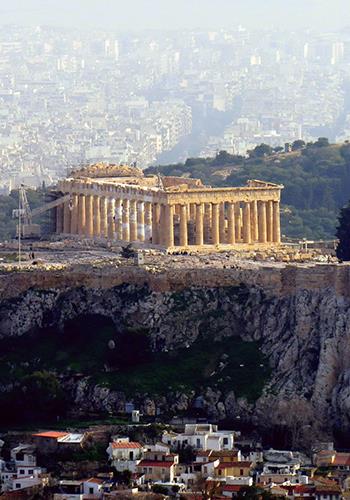
Athens is the capital of Greece and the center of the historic region of Attica. It is the largest city in the country, its economic and cultural center. Athens is one of the most important ancient Greek polises and a symbol of Western civilization. It is a city that many consider the cradle of European culture and science. Socrates, Plato, Aristotle, Sophocles, Euripides lived and worked here. The city is named after the goddess of wisdom Athena and is known for its Acropolis which is one of the largest ancient ruins in the world with amazing artifacts from ancient Greece.
Athens is not just a relic of the past. It is a lively, dynamic and modern capital. The appearance of the city was shaped by millennia of history and several ancient great civilizations. Here you can find monuments of ancient Greece and the Roman Empire, dazzling Byzantine churches and charming historic areas that still retain a wonderful rural atmosphere.
Athens is located in the southern part of Greece on the shores of the Saronic Gulf of the Aegean Sea. The city is located on the Athenian plain and is surrounded by mountains Egaleo, Parnis, Pendelikon and Imitos. Such features of the terrain often cause smog and air pollution. The rivers Kifisos, Ilisos and Picrodaphnia flow through Athens.
The climate is subtropical semi-desert. It is characterized by hot and dry summers. Winter is quite warm with very rare sub-zero temperatures. During the year in Athens falls only 400 mm of rainfall, most of which falls on the period from November to March. The most comfortable time to visit Athens is spring, when the weather is usually warm and warm.
Athens is famous for its excellent Greek cuisine. Popular street food: Gyros (Greek shawarma), souvlaki (fried kebabs in pita bread with tomatoes and onions), tiropita (cheesecake). Great fish and seafood can be sampled at the port of Piraeus. Clubs and bars are concentrated in the coastal area, in the area of Plaka, Kerameikos and north of Ermou Street. Although Athens is considered a safe city, fraud and theft occur quite often. Be vigilant and watch your things.
Athens is one of the oldest cities in Greece which was founded in the seventh millennium BC. There is a myth why the patron goddess Athena was chosen. The first Athenian king Kekrop invited two gods (Athena and Poseidon) to argue for patronage over the new city. To do this, it was necessary to bring the king a gift. Poseidon struck with a trident and a spring from the ground struck but the water in it was salty. Athena struck with her spear and an olive tree grew from the ground. Athena Kekropu liked the gift more. Athens flourished in the 5th century BC. During this period the city was one of the most important and most powerful polises of Ancient Greece, along with Sparta. Philosophy and culture flourished hereand democracy was the political system. In the second half of the 5th century BC Pericles' golden age came, the period of its greatest prosperity during which the Acropolis and the Parthenon were built. The heyday of Athens did not last long. After the Peloponnesian War, the city lost its position and in the Hellenistic era was subordinated to Macedonia. In 146 BC. Athens became an ally of Rome, but joined his opponents during the uprising. In 86 BC. BC the city was looted by the Romans and included in the Roman Empire. In the 3rd century AD. Athens fell into disrepair.