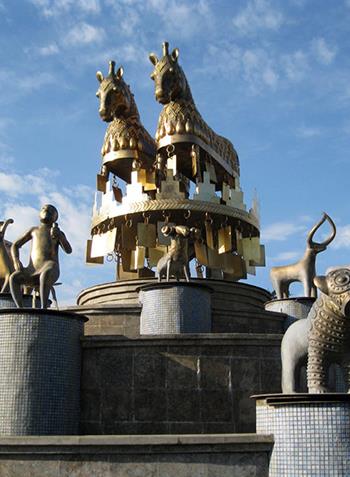
Kutaisi
Kutaisi is the third largest city in Georgia and the capital of the Imereti region. Located in the west of the country on the banks of the river Rioni. It is one of the oldest permanently inhabited cities in the world and one of the most beautiful in Georgia. It is believed that it was founded more than 4 thousand years ago. Since the time of the Ancient Colchis, Kutaisi has been considered the capital of Western Georgia and a traditional rival of Tbilisi. In addition, there are two attractions that are included in the list of UNESCO World Heritage Sites: the temple of Bagrat and the monastery of Gelati.
Geography and climate
Kutaisi is located in the western part of Georgia on the banks of the Rioni River, 220 km from Tbilisi and 150 km from Batumi . The average height above sea level ranges from 120 to 300 meters above sea level. The climate is moderately warm. Summers are hot and humid, winters are mild with slight frosts. Over 1000 mm of precipitation falls per year.
History
Some scholars suggest that Kutaisi was founded about 4,000 years ago. Archaeological excavations confirm that the settlement on the site of the modern city was already in the 5-6 century BC. The first written mention of Kutaisi dates back to the 2nd century BC and is associated with the famous poem of Apollonius of Rhodes "Jason and the Argonauts".
From ancient times Kutaisi was the capital of the ancient Georgian kingdoms: Colchis and Egrisi. In the 6th century, the city, as the capital of Egrisi, was located between the Persians and Byzantium. Since the 8th century, it has been the capital of the united state of Egrisi and Abkhazia. In the 10th century for more than a century the city had the status of a united Georgia.
In 1122 after the liberation of Tbilisi, Kutaisi lost its status as the Georgian capital. Despite this the city has not lost its significance throughout its history. In 1760 it was captured by the Turks, but 10 years later liberated by Russian troops. In 1810 Kutaisi was annexed to the Russian Empire.
How to get there
Kutaisi International Airport is 14 km from the city. Flights: Budapest, Vilnius, Kiev, Warsaw, London, Moscow . Buses and trains connect the city with Batumi, Tbilisi and Mtskheta .
Geography and climate
Kutaisi is located in the western part of Georgia on the banks of the Rioni River, 220 km from Tbilisi and 150 km from Batumi . The average height above sea level ranges from 120 to 300 meters above sea level. The climate is moderately warm. Summers are hot and humid, winters are mild with slight frosts. Over 1000 mm of precipitation falls per year.
History
Some scholars suggest that Kutaisi was founded about 4,000 years ago. Archaeological excavations confirm that the settlement on the site of the modern city was already in the 5-6 century BC. The first written mention of Kutaisi dates back to the 2nd century BC and is associated with the famous poem of Apollonius of Rhodes "Jason and the Argonauts".
From ancient times Kutaisi was the capital of the ancient Georgian kingdoms: Colchis and Egrisi. In the 6th century, the city, as the capital of Egrisi, was located between the Persians and Byzantium. Since the 8th century, it has been the capital of the united state of Egrisi and Abkhazia. In the 10th century for more than a century the city had the status of a united Georgia.
In 1122 after the liberation of Tbilisi, Kutaisi lost its status as the Georgian capital. Despite this the city has not lost its significance throughout its history. In 1760 it was captured by the Turks, but 10 years later liberated by Russian troops. In 1810 Kutaisi was annexed to the Russian Empire.
How to get there
Kutaisi International Airport is 14 km from the city. Flights: Budapest, Vilnius, Kiev, Warsaw, London, Moscow . Buses and trains connect the city with Batumi, Tbilisi and Mtskheta .