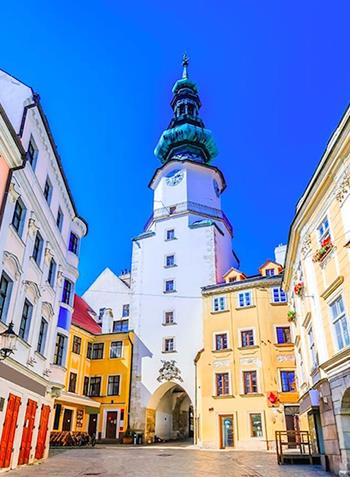
Bratislava
Bratislava is the capital and largest city of Slovakia. It is a place with a rich millennial history which offers a wonderful ancient charm and comfort of a small but dynamic city center. Bratislava has a beautiful Old Town with narrow winding streets and a pleasant medieval atmosphere, numerous historic churches and a picturesque hilltop hill next to the mighty Danube. This is a great tourist destination, which has many reasons not only to visit it, but then come back here again.
Bratislava is located in the extreme southwest of Slovakia at the foot of the Lesser Carpathians. The city is located on both banks of the Danube, as well as on the left bank of the Morava River. The Slovak capital is surrounded by charming villages, vineyards and agricultural lands. Bratislava has a temperate continental climate with warm(slightly rainy) summers and cool winters. Restaurants and cafes are most concentrated in the Old Town. Also for lunch or dinner you can walk to the Danube embankment, where there are many similar establishments. If you do not fall into the tourist trap, the prices in Bratislava for food are very reasonable.
Already in the 5th century BC. A Celtic settlement was founded on the castle hill, destroyed in 50 BC. by Dacians. Then German tribes began to penetrate here. In the 1st century AD. The Roman settlement of Herulata founded by the Romans three centuries later, was founded on the site of modern Bratislava. In the 5th century the Slavs came to these lands. From 623 to 907 Bratislava was part of the principalities of Same and Nitra as well as the Slavic state of Great Moravia.
The first mention of Bratislava dates back to 907 and is preserved in the chronicles of Salzburg . From 907 to 1918 the city was part of Hungary. Bratislava received city rights in 1291 becoming a free royal city. In the 14th and 15th centuries the future capital of Slovakia experienced a boom associated with the development of trade and crafts.
In 1536 Bratislava was declared the capital of Hungary. In fact it had such a capital status until 1830. The prosperity of Bratislava was slowed down in the 16th and 17th centuries. The reason for this was the war with the Ottoman Empire. Then the importance of Bratislava increased in the 18th century during the reign of Maria Theresa.
In the 19th century, Bratislava became the cradle of the Slovak national revival. In 1918 the city became part of Czechoslovakia, and since 1993 - the capital, cultural and political center of independent Slovakia.
Bratislava Castle is a symbol and the most famous monument of Bratislava. It is a magnificent historical monument that has risen over the Slovak capital for a thousand years. The first fortifications on the site of a modern castle appeared in prehistoric times and were built by the Celts. The fortress here was founded by the Slavs during the time of Great Moravia. The stone palace and church were built on Castle Hill in the 11th century. Three centuries later, the castle was rebuilt in the Gothic style. In the 16th - 17th centuries, this building after reconstruction acquired modern features (in the Renaissance and Baroque style).
Bratislava is located in the extreme southwest of Slovakia at the foot of the Lesser Carpathians. The city is located on both banks of the Danube, as well as on the left bank of the Morava River. The Slovak capital is surrounded by charming villages, vineyards and agricultural lands. Bratislava has a temperate continental climate with warm(slightly rainy) summers and cool winters. Restaurants and cafes are most concentrated in the Old Town. Also for lunch or dinner you can walk to the Danube embankment, where there are many similar establishments. If you do not fall into the tourist trap, the prices in Bratislava for food are very reasonable.
Already in the 5th century BC. A Celtic settlement was founded on the castle hill, destroyed in 50 BC. by Dacians. Then German tribes began to penetrate here. In the 1st century AD. The Roman settlement of Herulata founded by the Romans three centuries later, was founded on the site of modern Bratislava. In the 5th century the Slavs came to these lands. From 623 to 907 Bratislava was part of the principalities of Same and Nitra as well as the Slavic state of Great Moravia.
The first mention of Bratislava dates back to 907 and is preserved in the chronicles of Salzburg . From 907 to 1918 the city was part of Hungary. Bratislava received city rights in 1291 becoming a free royal city. In the 14th and 15th centuries the future capital of Slovakia experienced a boom associated with the development of trade and crafts.
In 1536 Bratislava was declared the capital of Hungary. In fact it had such a capital status until 1830. The prosperity of Bratislava was slowed down in the 16th and 17th centuries. The reason for this was the war with the Ottoman Empire. Then the importance of Bratislava increased in the 18th century during the reign of Maria Theresa.
In the 19th century, Bratislava became the cradle of the Slovak national revival. In 1918 the city became part of Czechoslovakia, and since 1993 - the capital, cultural and political center of independent Slovakia.
Bratislava Castle is a symbol and the most famous monument of Bratislava. It is a magnificent historical monument that has risen over the Slovak capital for a thousand years. The first fortifications on the site of a modern castle appeared in prehistoric times and were built by the Celts. The fortress here was founded by the Slavs during the time of Great Moravia. The stone palace and church were built on Castle Hill in the 11th century. Three centuries later, the castle was rebuilt in the Gothic style. In the 16th - 17th centuries, this building after reconstruction acquired modern features (in the Renaissance and Baroque style).