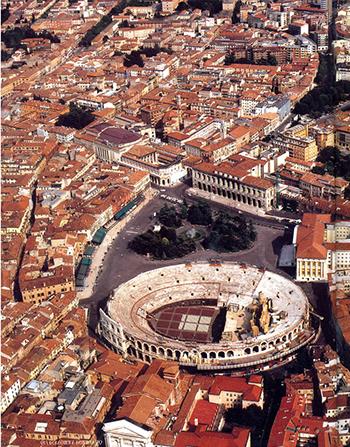
Verona
Verona is a city in northeastern Italy on the Adige River in the Venice region. This is an ancient corner of Veneto, famous as one of the most romantic places in the world due to the tragedy of "Romeo and Juliet" by William Shakespeare. Verona is two thousand years of history frozen in the streets of the city: the Ancient Roman Amphitheater, ancient churches and cultural monuments. It is a place that is literally imbued with romance and the past, and the historic center is a UNESCO World Heritage.
Geograhy and climate
Verona is located at the foot of the Lessin Mountains, 30 km from Lake Garda and 105 km from Venice. The city is crossed by the Adige River, which is part of the Po River Valley. The climate is temperate continental. Summers are dry and hot, winters are quite cool, with frequent fogs, light frosts and sparse snow. In ancient times, Verona was the focal point of all land and water transport systems in northeastern Italy. Four consular roads crossed here: Via Gallika, Via Claudia Augusta, Vikum-Veronezia and Via Postumia.
History
The exact date of the founding of the settlement on the site of Verona is not known. Perhaps there was a village of Etruscans or Eugene (local tribe). It is well known that in 89 BC Verona became a Roman colony. At this time, the city is actively growing, building and developing. In the 3rd century the city was used as a fortress on the way of the barbarians. At the beginning of the 5th century, the Goths under Alaric were defeated on the outskirts of the city.
The period after the collapse of the Roman Empire (5-7 centuries) seemed quite busy. In the 6th century the Goths were defeated by Byzantine troops, the Byzantines lost to the Lombards, who were defeated by the Franks in the 8th century. In the Middle Ages, the city was used mainly as a fortress. Until 1405, Verona was influenced by different dynasties: Romano, Visconti, Carrara, until it became part of the Venetian Republic. The city remained under the rule of Venice for 4 centuries.
At the end of the 18th century, Verona was captured by Napoleon's troops. After the Congress of Vienna, the city became part of the Habsburg Empire. In 1866 Verona became part of Italy. In 1882 there was a severe flood. The Adige River overflowed its banks and flooded most of the city. During World War II, the city was bombed several times.
How to get there
Verona has its own airport, which is located 12 km from the city. You can get to the city by bus, which goes to the main train station. The number of destinations and carriers is quite large: Kiev, Frankfurt, Munich, Paris, Rome, Madrid, Brussels, Palermo, London. Verona Porta Nuova Train Station is served by regional, high-speed and international services. Trenitalia trains connect the city with Venice, Milan, Turin , Rome, Trieste , Florence , Bologna . International destinations - Munich, Geneva , Paris , Dijon, Vienna . Verona is located at the intersection of two highways. From north to south - A22 (Modena - Brennero), east-west - A4 ( Milan - Venice).
Shopping
Via Mazzini is the main shopping street in Verona, located between Piazza Bra and della Erbe. Here you will find many expensive branded stores. Many different shops are located on Corso Porta Borsari. You can buy antiques at Corso Santa Anastasia.
Cuisine
Horse meat is very popular in Verona: pastissada de canal (horse stew) and picula de canal. Interestingly, there are not many pizzerias, but pasta is quite popular. Try pizzocheri (buckwheat pasta with cheese and sage), casoncelli (Verona ravioli), bigoli (thick spaghetti), casoela (pork casserole), bollito misto - a meat mix with pearà sauce, which is made only in Verona.
Attractions
Verona is a city with a rich and long history. Here you can find both monuments of the ancient period and the Middle Ages.
The Arena is the main attraction of Verona and one of the largest amphitheaters ever built by the Romans. The arena was built in the 1st century for gladiatorial combat. The elliptical shape is designed to accommodate a large number of spectators and had good acoustics (the amphitheater accommodated about 30,000 people). The arena was built outside the walls of the Roman city to avoid the crowds in its center. Most of the outer ring of the amphitheater was damaged during the earthquake of 1117, but the inner part is well preserved. Also, the outer ring was destroyed in the 5-6 century to build a second city wall. During the Renaissance, the Arena was dismantled for the construction of new buildings. In the Middle Ages there were numerous benches. Now summer opera seasons are held here.
Juliet's house is a symbol of Verona, a place of attraction for huge crowds of tourists. Probably the site of a famous scene with the well-known tragedy of the genius Shakespeare. In fact, the house has nothing to do with Juliet. Although the building is old (13th century). The balcony was added in 1936 and declared the "house of Juliet" to attract tourists. With what successfully copes. Usually a small yard is filled with couples in love, who are photographed on the balcony, leave notes on the famous wall and touch the chest of the sculpture.
The tomb of the Scaligers is a monumental burial complex in the Gothic style of the Della Scala family, designed to store the tombs of its most prominent representatives. The tomb is enclosed in a wrought iron fence. The oldest sarcophagus dates back to the 14th century.
Erbe is the oldest square in Verona, the heart of the ancient Roman city. On the perimeter of the square is surrounded by palaces (palazzo). There is also a fountain in the square.
Lamberti is the tallest tower in Verona, completed in the 15th century. The beginning of the construction of the tower dates back to the 11th century. Its height is 84 meters. To climb to the top you need to overcome 238 steps. Although the tower has an elevator. In 1295, two bells were installed on the tower: the Marangana bell signaled the end of work for artisans or an alarm in case of fire, the Renault bell gathered the city council or called for weapons in case of danger to the city. Lambert clocks were installed in the late 18th century.
Gardello is a brick tower on the left side of Erbe Square, often called the clock tower. The tower was built in the 14th century.
The Duomo is a cathedral built in the 12th century on the site of an old 8th century church destroyed during an earthquake. The Duomo has an ornate marble Romanesque façade and a bell tower. The interior contains many works of art.
Santo Stefano is one of the oldest early Christian churches in Verona founded in the 5th century. The church houses precious paintings of the 14th century and works by Renaissance artists Karoto, Farinati and Brusasorga.
San Giorgio is a church with an amazing dome (designed by Michele Sanmicelli) dominates the banks of the Adige. The Romanesque tower was shortened to make room for the dome, and the interior of the church contains precious works of art, including Tintoretto's Baptism of Christ, works by Domenico and Felice Brusasorza, Caroto and Farinata.
San Giovanni is a church founded during the Lombard era. It was probably built on the site of a pagan temple dedicated to the worship of the sun. Destroyed during the earthquake of 1117. It was completely rebuilt in a wonderful Romanesque style and is one of its best examples.
San Zeno is perhaps the most beautiful Church of Verona with the richest interior. Located a little away from the city center, a 15-minute walk from Castelvecchio. Dedicated to St. Zeno is the patron saint of Verona. The Romanesque basilica was restored after an earthquake in 1117 on the foundations of a 4th or 5th century building. Note the exterior façade with a large pink window called the Wheel of Fortune, marble bas-reliefs on both sides of the porch, the famous bronze door, the bell tower and the abbey tower. Inside the church you can see frescoes of the 13th and 14th centuries, a baptismal font, a ceiling with a ribbed vault, where the remains of San Zeno, a statue of the saint.
Santa Anastasia is a Gothic church built between 1290 and 1481. Pay attention to the unfinished facade with a magnificent Gothic portal. Inside you can see altars and chapels with works by Pietro and Forlezza, Cattaneo, Michele and Florence, Liberals and Verona, Girolamo dai Libri, Giolfino, Brusasorci.
Piazza Bra is the central square of modern Verona and the starting point for exploring the old town. On the west side of the square you can see the gate "Portoni della Bra", which is the entrance to the square and the majestic palace. On the south side is the neoclassical Barberini Palace.
The Museum of Lapidary Inscriptions collects epigraphs and other finds of different periods: Etruscan, Greek, Roman.
Castelvecchio is the largest medieval building in Verona. This brick castle was built on the banks of the Adige in the 14th century. Now within its walls is a museum.
Peter's Bridge was built in the 1st century. Repeatedly destroyed and rebuilt. The original Roman arches can still be seen on the left bank of the Adige. Also here are the remains of a Roman wall.
Piazza Signoria is the most elegant square in Verona. In this square you can admire many palaces: Palazzo della Ragione and Cortile Mercato Vecchio, Palazzo del Capitano and Palazzo del Guando, Loggia del Consiglio and Domus Nova. In the center is a sculpture of Dante.
The Romanesque Theater is an ancient Roman theater built in the 1st century AD. The archeological museum of the theater houses important artifacts and finds of Verona's Roman past.
Borsari is an ancient gate that was the entrance to the city. Today only the facade is preserved. Its decorative elements were added later. Porta Borsari was essentially a fort with observation towers, a courtyard and a garrison.