Strasbourg
Strasbourg is a city in eastern France, the capital of Alsace and the prefecture of the Bas-Rhin department. It is an ideal stop between France and Germany, surprisingly combining the medieval past and present. Strasbourg is an incredible Gothic cathedral, narrow streets and half-timbered houses of the Grand Elijah, canals and amazing cuisine. In addition the city is the parliamentary capital of Europe (the European Parliament sits here) and one of the largest university centers in France.
Strasbourg is one of the most beautiful cities in eastern France which looks like it came from the pages of fairy tales or fantasy. Its real gem is the old town - Grand Ile. Interestingly, the historic center of Strasbourg was one of the first (among all other European cities) included in the list of UNESCO World Heritage Sites.
Strasbourg is located in eastern France on the banks of the river Ile (west bank of the Rhine) near the border with Germany, between the Vosges and the Black Forest. The city lies on the plains of Alsace and occupies a favorable central position in Western Europe. At the same time, historically and geographically Strasbourg is closer to Germany which leaves some German imprint on it.
The climate is temperate continental with warm summers and fairly cool winters. Despite the fact that the average winter temperature is generally positive, frosts and snowfalls are often possible. Due to the location between the two mountains, Strasbourg is not prone to strong winds. Strasbourg can be visited all year round. But the best time to visit is the warm season and the pre-Christmas period.
Strasbourg is quite popular with tourists due to the beautiful pedestrian center of the city, which can be easily explored on foot. Some areas, especially close to the cathedral, attract large tourist groups. Especially in summer and during the Christmas holidays. It is better to explore them outside rush hour - in the evening or early morning.
The name "Strasbourg" can be translated as "fortress (castle) by the road". Already in the 3rd century BC there was a Celtic settlement at this place. During the Roman Empire there was one of its border towns - Argentorat.
After the collapse of the Roman Empire, the city was occupied by the Germanic tribes of the Alemanni, who, in turn, were absorbed by the Franks. The name Strasbourg originated in the early Middle Ages. After the collapse of the Frankish kingdom, Alsace became part of the Holy Roman Empire. Strasbourg remained part of Germany until the 17th century, even after receiving the status of a free imperial city in the 13th century.
History and facts
In 1349, one of the bloodiest events of the Middle Ages took place in Strasbourg, when more than a thousand Jews were publicly burned in its squares. The persecution of the Jewish population here lasted until the 18th century. Strasbourg was one of the first Protestant cities in Germany to adopt the Lutheran faith in the early 16th century. Because of this, it became one of the European centers of humanitarian education and book printing. The first newspaper in Europe was published in Strasbourg.
In 1681, Louis XIV took advantage of the chaos of the Thirty Years' War and annexed the capital of Alsace to France. The status of Strasbourg as a free city ended after the French Revolution. After the Franco-German War of 1870, the Germans reunited the city and pursued a policy of Germanization that led to the expulsion of those who preferred to remain French. After the defeat of Germany in the First World War, the city returned to France. And now it was the turn of the French to try to eradicate the traces of Germanization. During World War II, the Nazis considered Alsatians to be compatriots. Therefore, many of them were forced to fight in the German army.
Today, Strasbourg is one of the ten largest cities in France, is one of the centers of French learning and European politics.
How to get there
Strasbourg has its own international airport. But there is one nuance - the number of destinations is quite limited and they are all quite expensive. The best choice is Basel Airport. From Basel Airport you can take a bus to Saint-Louis Train Station and then to Strasbourg. Some budget low-cost carriers fly to Karlsruhe Airport. The best way to get from there to Strasbourg is to take bus 285 to Baden-Baden train station (3.40 euros, travel time about 25 minutes), then by train.
Strasbourg has access to the motorways connecting it with the West (A4), the South (A35) and the East (A5). Keep in mind that in France most motorways are tolled. Highways to Strasbourg can be easily and quickly reached from: Paris, Lyon, Basel, Frankfurt, Brussels, Stuttgart.
Strasbourg has a high-speed train connection with Paris and some other cities: Lyon, Dijon, Metz, Marseille, Bordeaux, Lille, Frankfurt etc. The train station is located in the western part of the city.
Shopping
A flea market is open on the rue de Vieil-Hôpital on Wednesdays and Saturdays. To the north of the city center is Place Des Halles - a shopping center with more than 100 shops. In 2008, a new shopping center, Rivetoile, was opened in Strasbourg, located between the Etoile Polygone and Etoile Bourse tram stops. Designer clothing can be purchased at Galeries Lafayettes, Rue Hellebardes and Gutenberg Square.
Cuisine
Alsace is one of the most famous gastronomic regions of France. There is a large number of exquisite high quality products. Foie gras and sauerkraut are the two centers of Alsatian cuisine. Popular are baeckeoffe (stewed pork or beef), tarte flambée (similar to pizza) and spaetzle (various pasta), which are a side dish to fish and poultry. For dessert, Alsace serves a variety of pies and the famous ball shop. Local wines are very popular and well-known.
Attractions
Grand Ile is the heart of Strasbourg, a large island formed by the river Ile. This is an ideal place to explore the city and its historic atmosphere. Grand Ile is actually the historic center of Strasbourg. Here are its main attractions: Strasbourg Cathedral (Notre Dame de Strasbourg), other medieval churches and historic buildings.
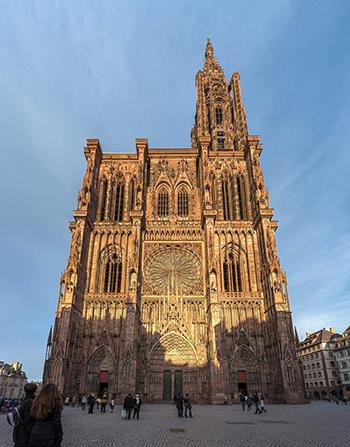
Strasbourg Cathedral (Notre Dame de Strasbourg) is one of the most grandiose Gothic churches in Europe and a beautiful monument of medieval architecture. The great Victor Hugo spoke about him - "A giant and delicate monster." The cathedral was built between 1176 and 1439 and has a 142-meter tower (completed in 1439), the tallest in France. To climb the observation deck you need to overcome 322 steps. The cathedral has a 300-year-old astronomical clock. Entrance to Strasbourg Cathedral is free.
Every day at 12:30 the astronomical clock reflects a small performance from the life of Christ and a parade of apostles. Externally, the facade is a giant picture of the Middle Ages: hundreds of sculptures stand out from the walls and emphasize the play of light and shadow. And the pink sandstone, from which Notre Dame is made, changes color depending on the time of day.
Church of St. Thomas - the Protestant Church, a masterpiece of Gothic art in Alsace. It is one of the few surviving Protestant churches since the Reformation. Inside is the mausoleum of Marshal Sachs - a masterpiece of Baroque.
Church of St. Paul - a beautiful neo-Gothic building of the late 19th century. This Protestant church is located on the edge of the island of Ile Saint Helen.
Saint-Pierre-les-Jun is a Protestant church built in the Gothic style on the site of an ancient 11th-century chapel of the Merovingian period. This former monastery church has preserved some Romanesque elements and frescoes of the 14th century.
Gutenberg Square is an area a few steps from Notre Dame de Strasbourg. Named after the inventor of printing Johann Gutenberg. A monument to him has been erected on the square. This place was one of the centers of Strasbourg from the Middle Ages to the 18th century.
Kleber Square is the main public square in Strasbourg. This is a place for various events and fairs, the main Christmas tree of the city is installed here.
Rogan's Palace is a historical monument in Grand Mule, which now houses 3 museums: the Archaeological Museum and the Museum of Fine and Decorative Arts. It was built between 1731 and 1742. Rogan's palace is considered a masterpiece of French Baroque.
The Kammerzel House is one of the most beautiful houses in Strasbourg. This typical Alsatian half-timbered house with a beautiful carved façade was built in the 15th century and is located in the historic center.
"Little France" is one of the most beautiful places in Strasbourg, a historic district (island) with beautiful half-timbered houses by the water. Here in the Middle Ages lived artisans, fishermen and millers. It is a pedestrian zone.
Not far from Little France are "covered bridges"(Les Ponts Couverts), which have retained their name, despite the fact that they no longer have roofs. Bridges were built to serve as a shaft for fortifications on waterways. They were used to connect the three medieval towers, the remains of ancient ramparts and covered wooden galleries which have now disappeared.
Vauban Dam is a barrier dam designed by the famous French Marshal and military engineer Vauban. The dam was built to protect Strasbourg, when after the evolution of artillery and warfare, the walls were no longer a reliable protection. The dam allowed, closing its arches, to quickly raise the level of the river Ile. If you go up to the roof, you can admire the maze of Strasbourg canals and "Little France".
Broel Square is more like a long alley. There are several magnificent mansions of the 18th century, as well as the town hall, the prefecture and the opera house.